Interpretable CNN-LSTM Framework for Multiclass Neuromuscular Disorder Classification Using Clinically Relevant EMG Features
IEEE Transactions on Artificial Intelligence, vol. 7, no. 6, pp. 3383-3398, 2026
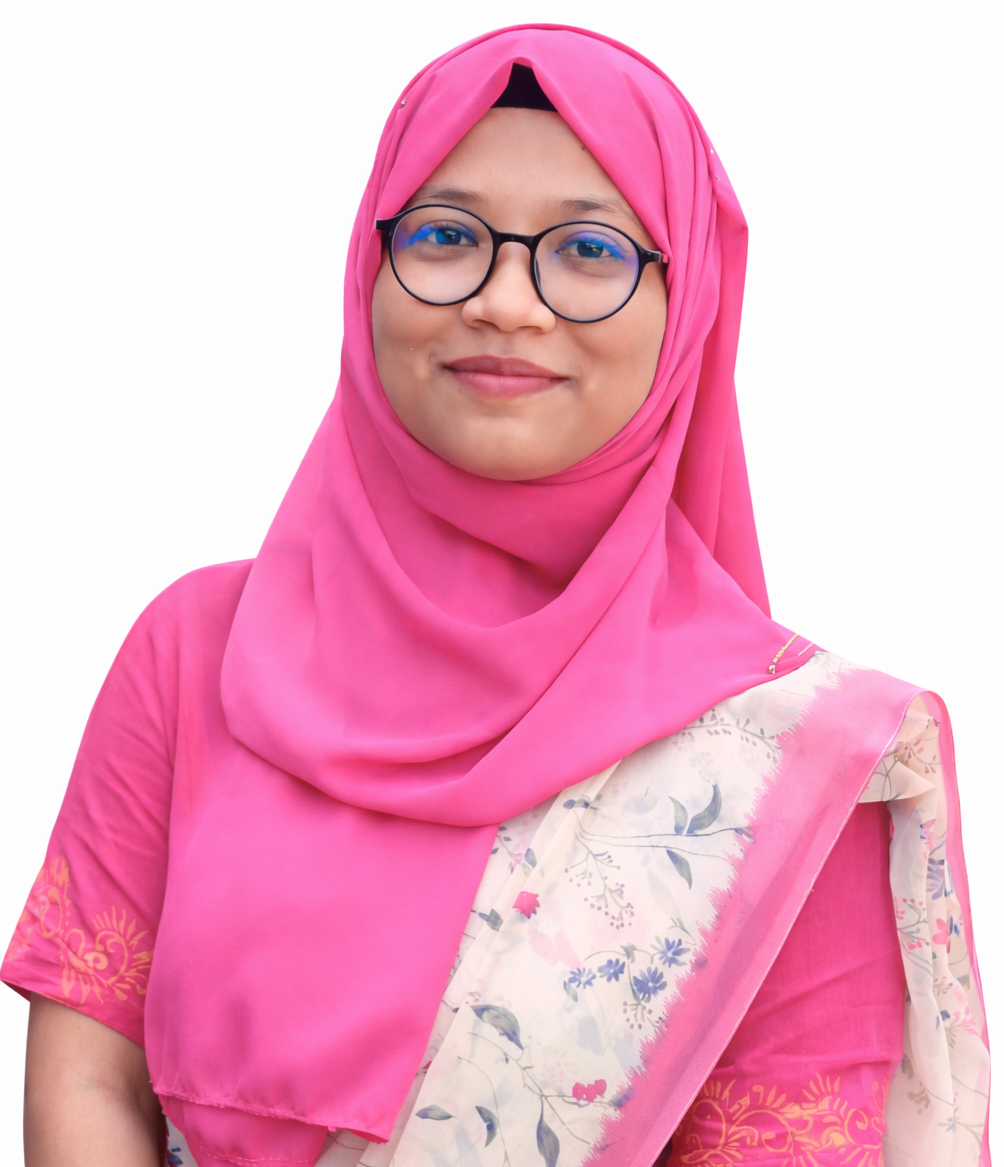
Hello!
I am Anika Tasnim Ritu, a Lecturer in the Department of Electrical & Electronic Engineering at Bangladesh Army University of Engineering & Technology (BAUET), Natore, Bangladesh.
I completed both my Master of Science and Bachelor of Science at the Department of Electrical & Electronic Engineering, Rajshahi University of Engineering & Technology (RUET), Bangladesh.
My research focuses on computational methods for healthcare, particularly physiological signal processing, wearable health sensing, and medical image analysis. I am interested in developing robust, trustworthy, and interpretable machine-learning methods and in exploring self-supervised representation learning and multimodal learning for healthcare applications where labeled clinical data are limited.
Outside research and teaching, I enjoy traveling, reading, and cooking.
Interpretable CNN-LSTM Framework for Multiclass Neuromuscular Disorder Classification Using Clinically Relevant EMG Features
IEEE Transactions on Artificial Intelligence, vol. 7, no. 6, pp. 3383-3398, 2026
Robust Control of Renewable-Hydrogen Electrolyzer-Buck Converter Systems Using Modified Double Integral Sliding Mode Controller for Grid Ancillary Services
Journal of Power Sources, vol. 677, p. 239953, 2026
Domain-Adaptive Deep Learning for Robust Multi-Class Retinal Disease Screening Across Clinical Environments
Submitted to Discover Artificial Intelligence
EDNet-20: Enhancing Multi-Label Ocular Disease Detection through Deep Learning Optimization
Submitted to Discover Artificial Intelligence
GWO-RMF: A Meta-Heuristic Residual Manifold Framework for Interpretable Neuromuscular Disorder Classification Using Clinically Relevant EMG Features
Submitted to Applied Computational Intelligence and Soft Computing (Wiley)
Interpretable Lifestyle-Based Prediction of ECG-Derived Cardiovascular Phenotypes
IEEE International Conference on Signal Processing, Information, Communication and Systems (SPICSCON), 2026 (Presented; Top 2% Paper Award)
Unsupervised ECG-Lifestyle Clustering for Early Cardiovascular Phenotyping in Young Adults
IEEE International Conference on Signal Processing, Information, Communication and Systems (SPICSCON), 2026 (Presented)
Statistical Analysis of Physical Activity's Impact on Cardiovascular Health Using ECG and Lifestyle Metrics
2025 4th International Conference on Electrical, Computer and Communication Engineering (ECCE), pp. 1-6, 2025
Assessing the Relationship between Bodily Biological Parameters and Cardiac States of Different Subjects
2024 3rd International Conference on Advancement in Electrical and Electronic Engineering (ICAEEE), pp. 1-6, 2024
Comparative Analysis of Microcontrollers in Wearable Devices for Real-Time Arrhythmia Classification: An Embedded Machine Learning Approach
2024 6th International Conference on Electrical Engineering and Information & Communication Technology (ICEEICT), pp. 1327-1331, 2024
Detection of Neuromuscular Disorders from EMG Signals: A Machine Learning Approach
2026 IEEE 2nd International Conference on Quantum Photonics, Artificial Intelligence & Networking (QPAIN), pp. 1-6, 2026
Touchless IoT-Based Health Monitoring System for Elderly and Maternal Healthcare Applications with Real-Time Cloud Integration
International Conference on Power, Electronics, Communications, Computing, and Intelligent Infrastructure, 2026 (Presented)
Research mentor: Dr. Md. Zahid Hasan
First-author research published in IEEE Transactions on Artificial Intelligence
I led the end-to-end development of an interpretable deep-learning framework for multiclass neuromuscular disorder classification using electromyography (EMG) signals. I designed a domain-guided feature-engineering pipeline combining three statistical selection techniques with clinically relevant EMG descriptors, developed a hybrid CNN–LSTM architecture to capture spatial patterns and temporal dynamics, and incorporated SHAP, PDP, PFI, and LIME to provide global and instance-level explanations. To our knowledge, this work is among the first to apply a comprehensive suite of explainable AI techniques to multiclass NMD classification using clinically curated EMG features.
The framework was developed and extensively evaluated on the Mendeley intramuscular EMG (iEMG) dataset, followed by cross-population validation on EMGLAB and external cross-modality validation using a private surface EMG (sEMG) cohort, which I collected, preprocessed, and assessed for signal quality. It consistently outperformed state-of-the-art ML and DL baselines across multiple feature subsets, achieving 95.83% classification accuracy, 98.61% multiclass AUC, and a 59.56 ms median inference time per sample. I also developed a proof-of-concept real-time diagnostic application to demonstrate the framework’s interpretability and feasibility for resource-constrained healthcare settings.
Collaborative research
Contributed to GWO-RMF, an efficient framework that combines Isomap-based nonlinear manifold learning with an XGBoost classifier optimized using the Grey Wolf Optimizer. My work included methodological development, implementation, experimental evaluation, interpretation of the learned feature space, and computational-efficiency analysis. The framework was evaluated across intramuscular and surface-EMG cohorts, achieving 95.83% accuracy with a median inference time of 0.71 ms.
Collaborative research
Contributed to the implementation and evaluation of a hybrid CNN–Swin Transformer framework for retinal disease screening across different clinical imaging environments. The framework combines CycleGAN-based image harmonization with Domain-Adversarial Neural Network feature alignment to reduce performance degradation caused by domain shifts. I implemented software components, conducted analytical experiments, and contributed to formal analysis and manuscript preparation. The approach improved cross-domain classification accuracy by 13.42%.
Collaborative research
Contributed to the development of EDNet-20, an optimized convolutional neural network for detecting eight ocular diseases from color fundus images. My work included data curation, methodology development, software implementation, experimental evaluation, and manuscript preparation. The framework was validated on both public and independently collected private datasets, achieving 94.26% accuracy on the public dataset and 91.80% on the private dataset.
Research advisor: Dr. Ajay Krishno Sarkar
M.Sc. thesis: “The Impact of Lifestyle Factors on Cardiovascular Health among Young Adults”
Investigated associations between lifestyle behavior and cardiovascular function by collecting 60-second resting ECG recordings and lifestyle measurements from 56 young adults. The study combined ECG-derived heart-rate variability, morphological, and interval features with physical activity, BMI, dietary behavior, and sleep quality. The work included signal preprocessing, feature extraction, statistical analysis, interpretable prediction, and unsupervised clustering. The clustering analysis identified two physiologically meaningful cardiovascular profiles: Active–Normal and Sedentary–Overweight.
I serve as course coordinator for an undergraduate cohort and teach theory and laboratory courses in Biomedical Signals and Systems, Electrical Circuits II, Electrical Measurement, Instrumentation and Sensors, and Microprocessors and Embedded Systems. I also serve as the laboratory in charge for the Electronic Circuits Laboratory, supporting laboratory instruction and related academic activities.
Alongside my teaching responsibilities, I supervise undergraduate theses and Integrated Design Projects (IDPs), mentoring students from topic formulation and system design through implementation and manuscript preparation. Research conducted under my supervision has resulted in publications at IEEE conferences.
Rajshahi University of Engineering & Technology (RUET)
Rajshahi University of Engineering & Technology (RUET)
Cantonment Public School & College, Rangpur
Dinajpur Government Girls' High School
Python, MATLAB, C/C++
PyTorch, TensorFlow, Keras, Scikit-learn, NumPy, Pandas, Explainable AI
MATLAB/Simulink, Proteus, Multisim
Arduino, STM32, Raspberry Pi, IoT devices and sensors
LaTeX, Microsoft Office, Git, GitHub, Microsoft Visio, Draw.io, EndNote
Awarded for Interpretable Lifestyle-Based Prediction of ECG-Derived Cardiovascular Phenotypes, August 2026.
Awarded four national merit scholarships for performance in national public examinations, with scholarship support spanning 2009–2022: PSC Talent Pool Scholarship (18th), JSC General Scholarship, SSC Talent Pool Scholarship (13th), and HSC Talent Pool Scholarship (7th) under the Dinajpur Education Board.